
Blog

Introduction to Data Warehousing :Definition, Architecture & Uses
Introduction to Data Warehousing :Definition, Architecture & Uses
January 7, 2026
Introduction to data warehousing covering definition, architecture, benefits, and why data warehouses are critical for analytics and data engineering.
.avif)
.png)
INTRODUCTION TO DATA WAREHOUSING
We construct a Data Warehouse by integrating data from various sources. This processsupports analytical reporting, structured and unstructured queries, and organizationaldecision-making. We follow a step-by-step approach to build and use a Data Warehouseeffectively. Many data scientists get their data in raw formats from various sources of dataand information. But, for many data scientists also as business decision-makers, particularlyin big enterprises, the main sources of data and information are corporate data warehouses. Adata warehouse holds data from multiple sources, including internal databases and Software(SaaS) platforms. After we load the data, we often cleanse, transform, and check it for qualitybefore using it for analytics reporting, data science, machine learning, or other purposes.
WHY DATA WAREHOUSE IS IMPORTANT IN DATA ENGINEERING ?
A Data Warehouse is a core part of data engineering because it provides a structured,organized, and reliable place to store large amounts of business data so it can be analyzed andused for decision-making.
Here some key Benefits and Importance :
- Centralized Storage: Stores data from multiple sources in one place.
- Clean & Consistent Data: Removes errors and standardizes data for better reliability.
- Historical Analysis: Keeps years of data for trend and performance analysis.
- Better Performance: Handles heavy analytical queries without affecting dailysystems.
- Supports BI & Analytics: Foundation for dashboards, reports, AI/ML models.
- Decision Making: Helps management understand data insights and plan strategies.
- Core of Data Pipelines: Data engineers build ETL/ELT pipelines around thewarehouse
WHAT IS DATA WAREHOUSE ?
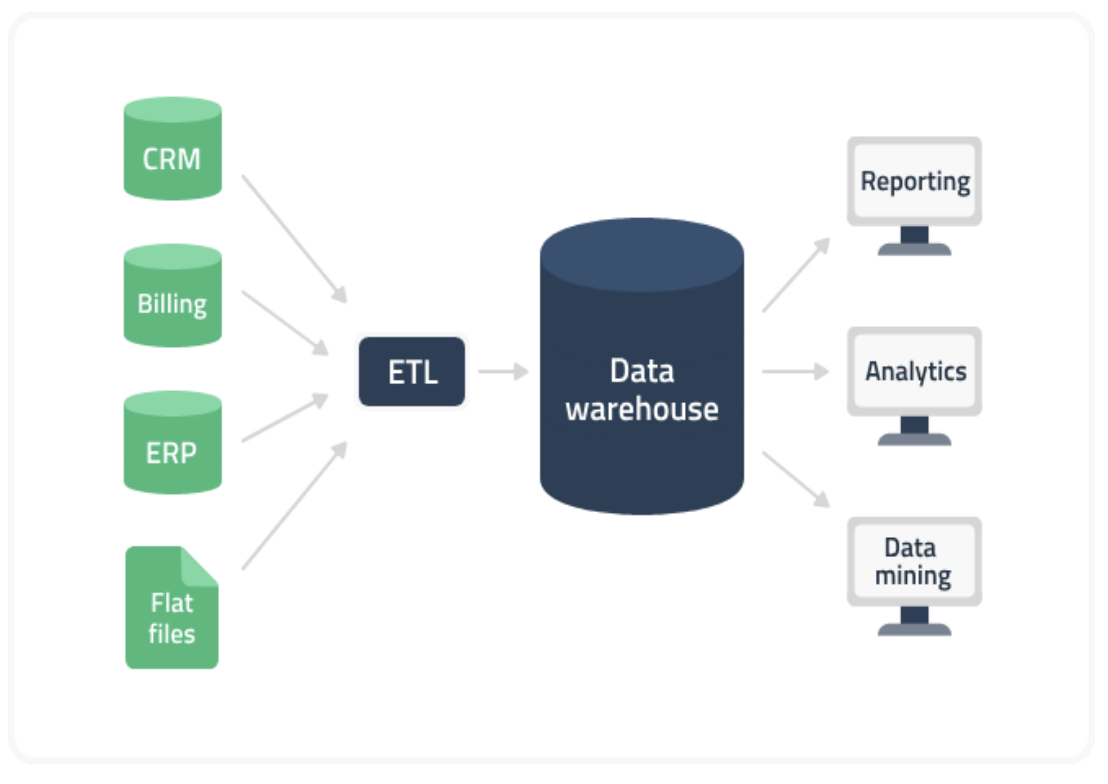
A Data Warehouse is a collection of software tools that facilitates analysis of a large set ofbusiness data used to help an organization make decisions. A large amount of data in datawarehouses comes from numerous sources such that internal applications like marketing,sales, and finance; customer-facing apps; and external partner systems, among others. It is acentralized data repository for analysts that can be queried whenever required for businessbenefits. We construct a Data Warehouse by integrating data from various sources. Thisprocess supports analytical reporting, structured and unstructured queries, and organizationaldecision-making. We follow a step-by-step approach to build and use a Data Warehouseeffectively
NEED OF DATA WAREHOUSING :
Data Warehousing is a progressively essential tool for business intelligence. It allowsorganizations to make quality business decisions. The data warehouse benefits by improvingdata analytics, it also helps to gain considerable revenue and the strength to compete morestrategically in the market. By efficiently providing systematic, contextual data to thebusiness intelligence tool of an organization, the data warehouses can find out more practicalbusiness strategies.
- Business User: Business users or customers need a data warehouse to look atsummarized data from the past. Since these people come from a non-technicalbackground, we should represent the data to them in an uncomplicated way
- Maintains consistency: We program data warehouses to apply a regular format to allcollected data from different sources. This makes it effortless for company decisionmakers to analyze and share data insights with their colleagues around the globe. Bystandardizing the data, we reduce the risk of error in interpretation and improveoverall accuracy.
- Store historical data: Data Warehouses are also used to store historical data thatmeans, the time variable data from the past and this input can be used for variouspurposes.
- Make strategic decisions: Data warehouses contribute to making better strategicdecisions. Some business strategies may be depending upon the data stored within thedata warehouses.
Key Characteristics of Data Warehouse
- Subject Oriented:
A data warehouse is often subject-oriented because we design it todeliver insights on a particular theme. This means we propose the data warehousingprocess to handle a specific, well-defined theme. These themes are often sales,distribution, selling. etc.
- Time-Variant:
When we maintain data over different intervals of time, such asweekly, monthly, or annually, we establish numerous time limits. These limits arestructured between large datasets and are managed within the online transactionprocessing (OLTP) method. We extend the time limits for the data warehouse beyondthose of operational systems. We store data in the data warehouse with apredetermined interval of time and deliver information from a historical perspective.It contains parts of time directly or indirectly
- Non-volatile:
The data residing in the data warehouse is permanent and defined by itsnames.It also means that we cannot erase or delete data in the data warehouse, nor canwe insert new data into it freely. In the data warehouse, we treat data as read-only andrefresh it only at specific intervals. When we perform operations like delete, update,or insert in a software application, we lose these changes in the data warehouseenvironment. We can only perform two types of data operations in the datawarehouse:- Data Loading
- Data Access
- Integrated:
A data warehouse is created by integrating data from numerous differentsources such that from mainframe computers and a relational database. Additionally,it should also have reliable naming conventions, formats, and codes. Integration ofdata warehouse benefits in the successful analysis of data. Dependability in namingconventions, column scaling, encoding structure, etc.
Architecture and Components of the Data Warehouse
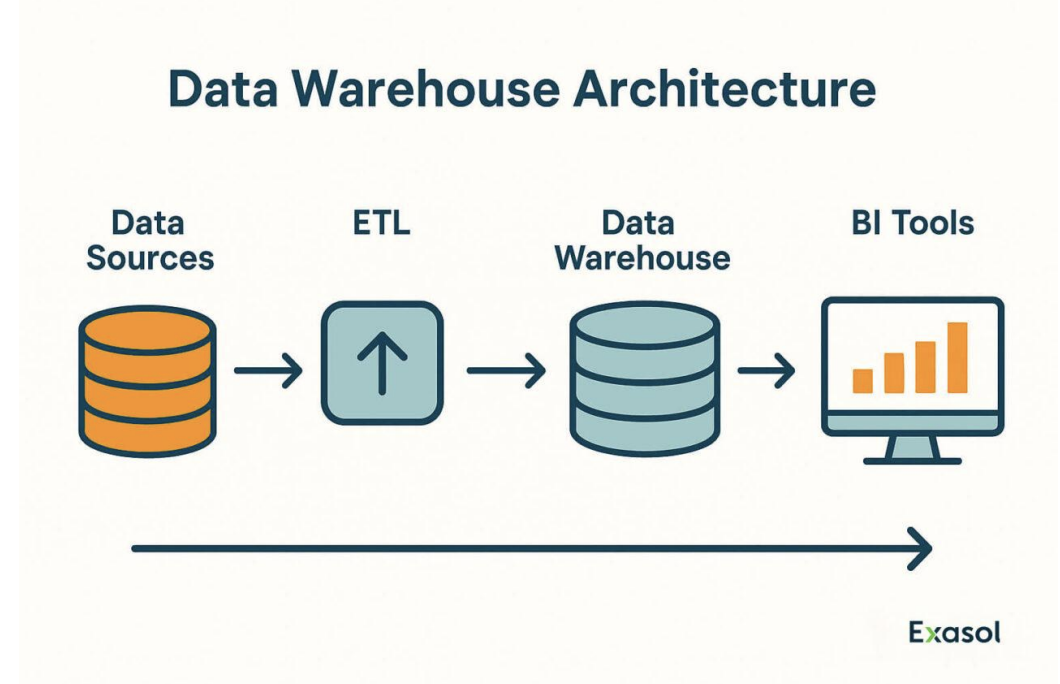
Data warehouse architecture defines the comprehensive architecture of dataprocessing and presentation that will be useful for data analysis and decision makingwithin the enterprise and organization. Each organization has different datawarehouses based on their needs, and we characterize all of them by certain standardcomponents.
The architecture of the data warehouse mainly consists of the proper arrangement of its elements, to build an efficient data warehouse with software and hardware components. The elements and components may vary based on the requirement of organizations. All of these depend on the organization’s circumstances.Data Warehouse applications are designed to support the user’s data requirements, an example of this is online analytical processing (OLAP). These include functions such as forecasting, profiling, summary reporting, and trend analysis.
Source Data Component:
In the Data Warehouse, the source data comes from different places. They are group into four categories:
- External Data: For data gathering, most of the executives and data analysts rely oninformation coming from external sources for a numerous amount of the informationthey use. They use statistical features associated with their organization, which theyobtain from external sources and departments.
- Internal Data: In every organization, the consumer keeps their “private” spreadsheets,reports, client profiles, and generally even department databases. This is often theinterior information, a part that might be helpful in every data warehouse.
- Operational System data: Operational systems are principally meant to run the business. In each operation system, we periodically take the old data and store it in achieved files.
ETL PROCESS:
After we extract the data from various sources, it’s time for us to prepare the data files for storage in the data warehouse. We must transform the extracted data collected from various sources and format it so that it is suitable for saving in the data warehouse for querying and analysis.The data staging contains three primary functions that take place in this part:
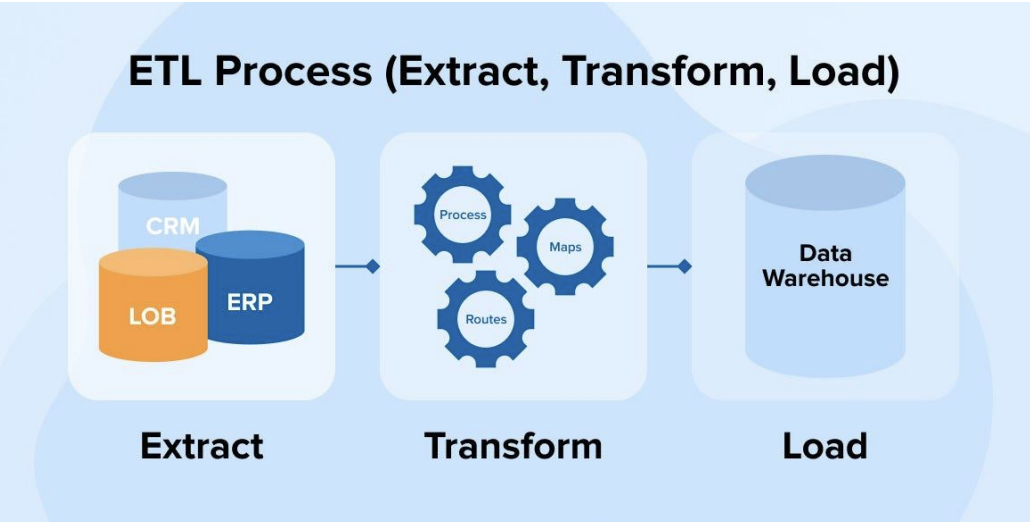
- Data Extraction: This stage handles various data sources. Data analysts should employ suitable techniques for every data source.
- Data Transformation: As we all know, information for a knowledge warehouse comes from many alternative sources. If information extraction for a data warehouse posture huge challenges, information transformation gifts even important challenges.We tend to perform many individual tasks as a part of information transformation.First, we tend to clean the info extracted from every source of data. Standardization of information elements forms an outsized part of data transformation. Data transformation contains several kinds of combining items of information from totally different sources. Information transformation additionally contains purging supply information that’s not helpful and separating outsourced records into new mixtures.Once the data transformation performs ends, we’ve got a set of integrated information that’s clean, standardized, and summarized.
- Data Loading: When we complete the structure and construction of the data warehouse and go live for the first time, we do the initial loading of the into the data warehouse storage. The initial load moves high volumes of data consuming a considerable amount of time.
Data Storage in Warehouse:
Data storage for data warehousing is split into multiple repositories. These data repositories contain structured data in a very highly normalized form for fast and efficient processing.
- Metadata: Metadata means data about data i.e. it summarizes basic details regarding data, creating findings & operating with explicit instances of data. We create metadata either manually by making additional corrections or automatically. This metadata contains basic information about the data.
- Raw Data: Raw data is a set of data and information that we have not yet processed. We deliver it from a specific data entity to the data supplier, and neither machines nor humans have processed it yet. We gather this data from online sources to provide deep insights into users’ online behaviour.
- Summary Data or Data summary: Data summary is an easy term for a brief conclusion of an enormous theory or a paragraph. This is often one thing where analysts write the code and in the end, they declare the ultimate end in the form of summarizing data. Data summary is the most essential thing in data mining and processing.
How does Data Warehouse work?
A Data Warehouse is like a central depository where data comes from different data sources. In a data warehouse, the data flows from the transactional system and relational databases. A data warehouse timely pulls out the data from various apps and systems, after then, the data goes through various processing and formatting and makes the data in a format that matches the data already in the warehouse. This processed data is stored in the data warehouses that ready for further analysis for decision making. The data formatting and processing depends upon the need of the organization
The Data could be in one of the following formats:
- Structured
- Semi-structured
- Unstructured data
The process and transform the data so that users and analysts can access theprocessed data in the Data Warehouse using Business Intelligence tools, SQLclients, and spreadsheets. A data warehouse merges all information coming fromvarious sources into one global and complete database. By merging all of thisinformation in one place, it becomes easier for an organization to analyze itscustomers more comprehensively.
Latest Tools and Technologies for Data Warehousing:
Data warehousing had improved the access to information, reduced queryresponse time, and also allows businesses to get deep insights from huge big data.Earlier, companies had to build lots of infrastructure for data warehousing. Buttoday the cloud technology has remarkably reduced the cost and effort of datawarehousing for businesses.
The field of data warehousing is rapidly emerging, and we are developing variouscloud data warehousing tools and technologies to enhance decision-making. Thecloud-based data warehousing tools are fast, highly scalable, and available on apay-per-use basis. Following are
Some data warehousing tools:
- Amazon Redshift
- Microsoft Azure
- Google BigQuery
- Snowflake
- Micro Focus Vertica
- Teradata
- Amazon DynamoDB
- PostgreSQL
- Amazon RD
- Amazon S3
All these are the top 10 Data Warehousing Tools. In this article, we are going touse Google BigQuery for data warehousing.
Applications Of Real-Time Data Warehouses
- Ecommerce
In the Dynamic eCommerce industry,RTDWs facilitate immediate data processing that is used to get insights into customer behavior, purchase , pattern, and website interaction. This enables marketers to deliver personalized content, targeted products recommendation, and swift customer service. Additionally, real – time inventory updates help maintain optimal stock levels, minimizing overstock or stork-out scenarios. - AI/ML
RTDWs empower AI/ML algorithms with new, up-to-date data. This ensures models make predictions and decisions based on the most current state of affairs.For instance, in automated trading systems, real-time data is critical for making split-second buying and selling decisions. - Healthcare
RTDWs in healthcare help improve care coordination. It provides instant accessto patient records, laboratory results, and treatment plans, improving carecoordination. They also support real-time monitoring of patient vitalsand provideimmediate responses to critical changes in patient Conditions. - Banking and finance
In banking and finance, RTDWs give you the latest updates on customertransactions, market fluctuations, and risk factors. This real-time financial dataanalysis helps with immediate fraud detection, instantaneous credit decisions, andreal-time risk management.
Conclusion on Data Warehousing
I hope you have given a good answer to the question “What is a dataWarehouse?” Hopefully, you should now have a good understanding of datastorage areas and why they are important in modern business. Now, you have toset up a database and upload all your different sources of information to it. I havecovered all the concepts that you will need to start using a Data Warehouse fromarchitecture & working to Different Tools and hope you like it.

Subscribe for next update
All Blogs
.png)