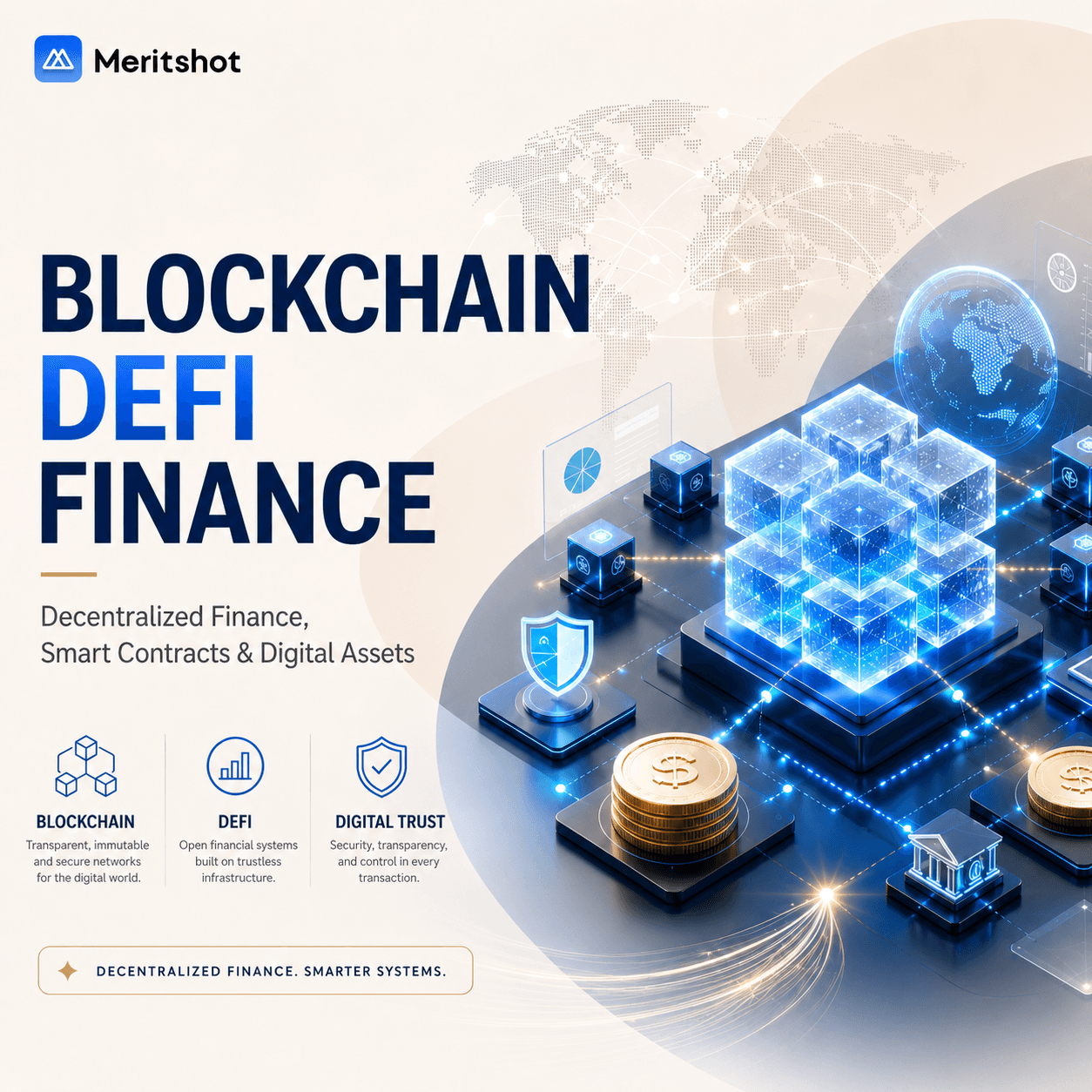
Blockchain and DeFi: What Every Finance Professional Should Know
Blockchain is no longer a niche buzzword confined to crypto trading forums. In 2025, major Indian banks are running blockchain pilots for cross-border payments, SEBI is exploring tokenized securities, and the RBI's Digital Rupee (e-Rupee) has crossed 1 million daily transactions. Whether you work in banking, insurance, capital markets, or fintech — blockchain literacy is becoming essential.
This guide breaks down what blockchain and DeFi actually are, how they work, and what they mean for your career in finance.
What is Blockchain? A Simplified Explanation
At its core, a blockchain is a distributed, immutable ledger — a shared database that no single entity controls, and where records cannot be altered once written.
Think of it like a Google Sheet that thousands of people have a copy of, but nobody can edit past entries. Every new entry (transaction) is verified by the network before it gets added.
How Blockchain Works
- Transaction initiated — A user requests a transaction (e.g., send 5 ETH to another wallet)
- Block creation — The transaction is grouped with others into a "block"
- Hashing — The block is given a unique cryptographic hash (a digital fingerprint) that also references the previous block's hash
- Consensus — Network participants (nodes) validate the block using a consensus mechanism (Proof of Work or Proof of Stake)
- Block added — Once validated, the block is appended to the chain permanently
- Transaction complete — The ledger is updated across all nodes simultaneously
The chain of hashes linking blocks together is what makes the ledger tamper-proof. Changing one block would invalidate every subsequent block, making fraud computationally impractical.

Smart Contracts Explained
A smart contract is a self-executing program stored on the blockchain that runs automatically when predefined conditions are met.
Think of it as an if-then agreement with no middleman:
- If Party A deposits INR 10,00,000 into the escrow contract AND Party B delivers the verified documents, THEN the funds are automatically released to Party B.
No lawyer, no bank, no manual processing. The code enforces the agreement.
Key Properties of Smart Contracts
- Autonomous — Execute without human intervention
- Transparent — Code is visible on the blockchain for anyone to audit
- Immutable — Once deployed, the contract cannot be altered
- Deterministic — Same inputs always produce the same outputs
Ethereum was the first blockchain to support smart contracts, and it remains the largest platform for decentralized applications (dApps).
What is DeFi (Decentralized Finance)?
DeFi is an ecosystem of financial applications built on blockchain — primarily Ethereum — that replicate traditional financial services without centralized intermediaries like banks, brokerages, or exchanges.
Instead of a bank holding your deposit and lending it out, a DeFi protocol uses smart contracts to automate lending, borrowing, trading, and yield generation.
Key DeFi Protocols
- Uniswap — Decentralized exchange (DEX) for swapping tokens without an order book. Uses automated market makers (AMMs) where liquidity providers earn fees.
- Aave — Lending and borrowing protocol. Deposit crypto to earn interest, or borrow against your holdings. Supports flash loans (instant, uncollateralized loans repaid within one transaction).
- Compound — Another lending protocol where interest rates are algorithmically determined by supply and demand.
- MakerDAO — Issues DAI, a decentralized stablecoin pegged to the US Dollar, backed by crypto collateral.
- Curve Finance — DEX optimized for stablecoin swaps with minimal slippage.
DeFi vs Traditional Finance
| Feature | Traditional Finance | DeFi |
|---|---|---|
| Intermediary | Banks, brokers, exchanges | Smart contracts |
| Access | KYC required, geography-restricted | Open to anyone with a wallet |
| Operating hours | Business hours, weekdays | 24/7/365 |
| Transparency | Opaque internal processes | Open-source, auditable code |
| Settlement time | 1-3 business days (T+1/T+2) | Minutes to seconds |
| Custody | Institution holds your assets | You hold your own keys |
| Yield on deposits | 3-7% (Indian FDs) | Variable, often 5-15% (with higher risk) |
| Regulatory protection | SEBI, RBI, DICGC insurance | Limited — code is the law |

Real-World Blockchain Use Cases Beyond Crypto
Blockchain's impact extends far beyond trading Bitcoin. Here are applications relevant to Indian finance professionals:
Supply Chain Finance
TradeLens (developed by Maersk and IBM) used blockchain to digitize global shipping documentation. Indian ports including JNPT explored integration. The concept of verified, tamper-proof trade documents reduces fraud and speeds up letter of credit processing.
Digital Identity and KYC
Repeated KYC processes cost Indian banks thousands of crores annually. Blockchain-based KYC (like what IDRBT — the RBI's tech arm — has piloted) would allow verified identity credentials to be shared across institutions with user consent, eliminating redundant verification.
Trade Finance
HSBC India executed one of the first blockchain-based letters of credit for a trade transaction with ING Bank. Blockchain reduced the processing time from 5-10 days to under 24 hours.
Insurance Claims
Parametric insurance on blockchain can automate crop insurance payouts for Indian farmers. If a weather oracle confirms that rainfall fell below a threshold, the smart contract automatically disburses the claim — no paperwork, no delays.
Government and Public Records
Andhra Pradesh piloted blockchain for land registry records to reduce property fraud. Telangana explored blockchain for governance and data integrity initiatives.
RBI's Stance on Crypto and Blockchain in India
India's regulatory landscape has been evolving:
- 2018 — RBI imposed a banking ban on crypto transactions (later overturned by the Supreme Court in 2020)
- 2022 — Finance Ministry introduced a 30% tax on crypto gains with no offset for losses, plus 1% TDS on transactions above INR 10,000
- 2022-2025 — RBI launched the Digital Rupee (e-Rupee) CBDC pilot across multiple banks including SBI, ICICI, and HDFC
- 2025 — SEBI published a consultation paper exploring regulated tokenization of securities and blockchain settlement infrastructure
The key takeaway: India is anti-unregulated-crypto but pro-blockchain-technology. The RBI and SEBI see value in blockchain infrastructure while wanting oversight on speculative crypto trading.
Risks and Challenges
- Smart contract bugs — Code vulnerabilities have led to billions in losses (the 2022 Wormhole bridge hack lost $320 million)
- Regulatory uncertainty — Rules vary by jurisdiction and are still evolving in India
- Scalability — Ethereum processes ~30 transactions per second vs Visa's ~65,000. Layer 2 solutions (Polygon, Arbitrum) are addressing this
- Private key management — Lose your private key and your funds are gone forever. No customer support line to call
- Volatility — Crypto-collateralized DeFi is subject to extreme price swings that can trigger cascading liquidations
- Energy consumption — Proof of Work blockchains consume significant energy (Ethereum's shift to Proof of Stake reduced its energy use by 99.95%)
Career Opportunities in Blockchain
The demand for blockchain-literate finance professionals is growing across India:
- Blockchain Developer — Solidity (Ethereum), Rust (Solana), smart contract auditing
- DeFi Analyst — Evaluating protocol risks, tokenomics, and yield strategies
- Compliance and RegTech — Navigating crypto regulations, AML for digital assets
- Product Manager (Web3) — Building blockchain-based financial products
- Blockchain Consultant — Advising banks and NBFCs on distributed ledger adoption
Companies hiring in India include Polygon (headquartered in India), CoinDCX, WazirX, Zerodha (exploring blockchain settlement), and major banks building internal blockchain teams.
Getting Started
If you are a finance professional looking to build blockchain literacy, here is a practical path:
- Understand the fundamentals — Read the Bitcoin whitepaper by Satoshi Nakamoto (just 9 pages). Then read the Ethereum whitepaper by Vitalik Buterin.
- Get hands-on — Create a MetaMask wallet, buy a small amount of ETH, interact with a DEX like Uniswap on a testnet.
- Learn Solidity basics — CryptoZombies (free) and Alchemy University offer excellent beginner courses for smart contract development.
- Study DeFi protocols — Read the documentation for Aave, Uniswap, and MakerDAO. Understand how their smart contracts work.
- Follow the regulation — Track SEBI and RBI publications on digital assets. Read the FATF guidelines on virtual asset service providers.
- Join communities — Polygon's developer community, ETHIndia hackathons, and India-focused blockchain meetups are great starting points.
Blockchain will not replace traditional finance overnight. But it is reshaping the infrastructure that finance runs on. The professionals who understand both worlds — traditional finance and decentralized systems — will be the most valuable in the years ahead.